Monday, May 18, 2009

Apollo 10 to the Moon!!

On May 18, 1969, Apollo 10 lifted off for the Moon, on what was the final "all-up" test of the Apollo mission hardware and flight procedures prior to the first attempt at a lunar landing. Given the critical importance of this mission, NASA selected an all-veteran crew to fly Apollo 10. Tom Stafford commanded the mission, John Young piloted the Command Module, and Gene Cernan was the LM Pilot.

Apollo 10 was an extremely exciting mission. This was America's second trip to the Moon, and we keenly experienced a sense of anticipation for this flight. The LM had performed flawlessly in Earth orbit on Apollo 9, but the risks seemed exponentially higher on this mission. What if something happened when the two craft were separated on the far side of the Moon?

There was also endless speculation in the press as to whether Stafford and Cernan would violate orders and try to fly the last 50,000 feet to the lunar surface. The press said that NASA had given the LM less fuel than it needed for the landing in order to preclude such a possibility. That of course was nonsense. Stafford would never have done anything that he hadn't trained for or that was outside of the flight plan. And the actual reason that the LM didn't have enough fuel to land was because this LM was overweight and couldn't have possibly carried enough fuel to support a landing. But it all made for great "What if?" conversation. That the crew dubbed the Command Module "Charlie Brown" and the LM "Snoopy" also added to the mission's popular appeal. We all knew that the success of this flight meant that we would try for a lunar landing in the summer.

The document at right is an official invitation to the Apollo 10 launch, extended to Mae Burke. Ms. Burke, call sign W3CUL, of Seminole, Florida, was a renowned amateur radio operator who provided invaluable service in establishing radio contact between servicemen overseas and their families back in America. At the time she earned an Edison Award, she had handled some 312,000 messages between 1949 and 1957. She earned a historic record of traffic handling honors over her lifetime handling overseas traffic for US service personnel, MARS, Red Cross and other emergency messages during the Korean, Vietnam and Cold War eras.

Also shown at left is a VIP guest badge for the viewing stands.

Saturday, May 16, 2009

Who's the best pilot you ever saw?

If you answered "Gordon Cooper," then you obviously have The Right Stuff.

Leroy Gordon "Gordo" Cooper's record-breaking spaceflight happened 46 years ago, on May 15 and 16, 1963. He made 22 orbits of the Earth in Mercury-Atlas 9, which he christened "Faith 7." During a flight that stretched over a day and a half, he became the first American to go to sleep in space. He also dealt with a plethora of issues, as the systems on his Mercury spacecraft, which were not designed for long-duration flight, began to break down.

These access badges are the only Mercury-era badges in my collection. The one shown at left granted the bearer access to the Engineering and Operations Building, which was adjacent to Hangar AE in the NASA area at the Cape Canaveral Air Force Station. These buildings were renovated and now house operations related to NASA's Expendable Launch Vehicle program.

The other badge does not designate a level of access. However, the "22" indicates the targeted number of orbits for the mission.

Cooper's mission was considered a complete success. There was one Mercury spacecraft remaining, which Alan Shepard had hoped to fly - and had already dubbed Freedom 7 II. However, NASA decided to terminate the Mercury program and concentrate its efforts on Gemini and Apollo. Following Cooper's mission, it would be 22 months before the next Americans went into space.

Saturday, May 9, 2009

Happy Birthday, Vance Brand

Apollo-Soyuz pilot Vance Brand is 78 years young today. Jane and I had the pleasure of sitting at Vance and Bev's table at dinner at Spacefest in February this year. Someone said after Spacefest that they thought that Vance and Bev were the kind of people you would want to have as your next-door neighbors, and I certainly share that assessment. They were charming and very down-to-Earth folks!

After being selected as an astronaut in 1966, Vance's first "mission" was 2TV-1, an Earthbound simulation of a full-length Apollo mission, with the Command Module sealed inside a vacuum chamber for 8 days. I asked him if boredom was a problem during that time locked in a small capsule. He said that the real problem was that the 1-G toilet that had been installed in the capsule overflowed several days into the mission!

Vance served as backup Command Module Pilot for Apollo 15, and as backup Commander for Skylabs 3 and 4. When problems developed on the Skylab 3 spacecraft, he was pressed into service as Commander for the Skylab Rescue Mission, which ended up never flying. He eventually made it into space as CMP for the Apollo-Soyuz Test Project, the last Apollo mission. He subsequently commanded three Space Shuttle missions. On STS-35 in 1990, Vance was at age 59 the oldest person to fly in space, a record which was broken by John Glenn in 1998.

Sunday, May 3, 2009

Here's to John Glenn

Two friends of mine are having lunch with John and Annie Glenn tomorrow - at the Glenns' invitation!! While trying desperately not to be overwhelmed with envy, I thought I would put up this photo of something from my collection in the Senator's honor.

I meant to wear this button at Spacefest but forgot to take it with me. It's definitely going with me to the Astronaut Scholarship Foundation's Astronaut Autograph and Memorabilia Show in November!

Whilst awaiting delivery of my tasty quad venti skim latte at Starbucks this morning prior to church, a man walked up to me and asked if I had ever been involved with the Space Station Freedom program. I told him that I had, in 1987-1989. He said that sounded like the right time frame. He said he was from JPL and he knew he recognized me from then. He then said, "You were Chris Kraft's replacement at Johnson Space Center, right?" That's where I had to say "no." He said that I am a dead ringer for the fellow that stepped in for Kraft after Kraft retired in 1982, when it was announced that the Space Station program would be managed in the Washington, DC area.

Saturday, April 25, 2009

Staking my claim to lunar real estate

On April 27, 1972, when I was in high school, I purchased from Lunar Services Corporation of Alexandria, Virginia, a deed to a small portion of lunar real estate near the crater Agrippa, for the grand total of $5.00. The purchase was documented with the quitclaim deed shown in this post, as well as several lunar maps.

I would have been surprised in 1972 to hear that it may be 50 years before anyone goes back to the Moon. I guess my chances of putting my own feet on "my property" are pretty slim. I'm especially upset that Lunar Services Corporation is apparently no longer around to help me assert my claim!

Friday, April 24, 2009

Project Highwater

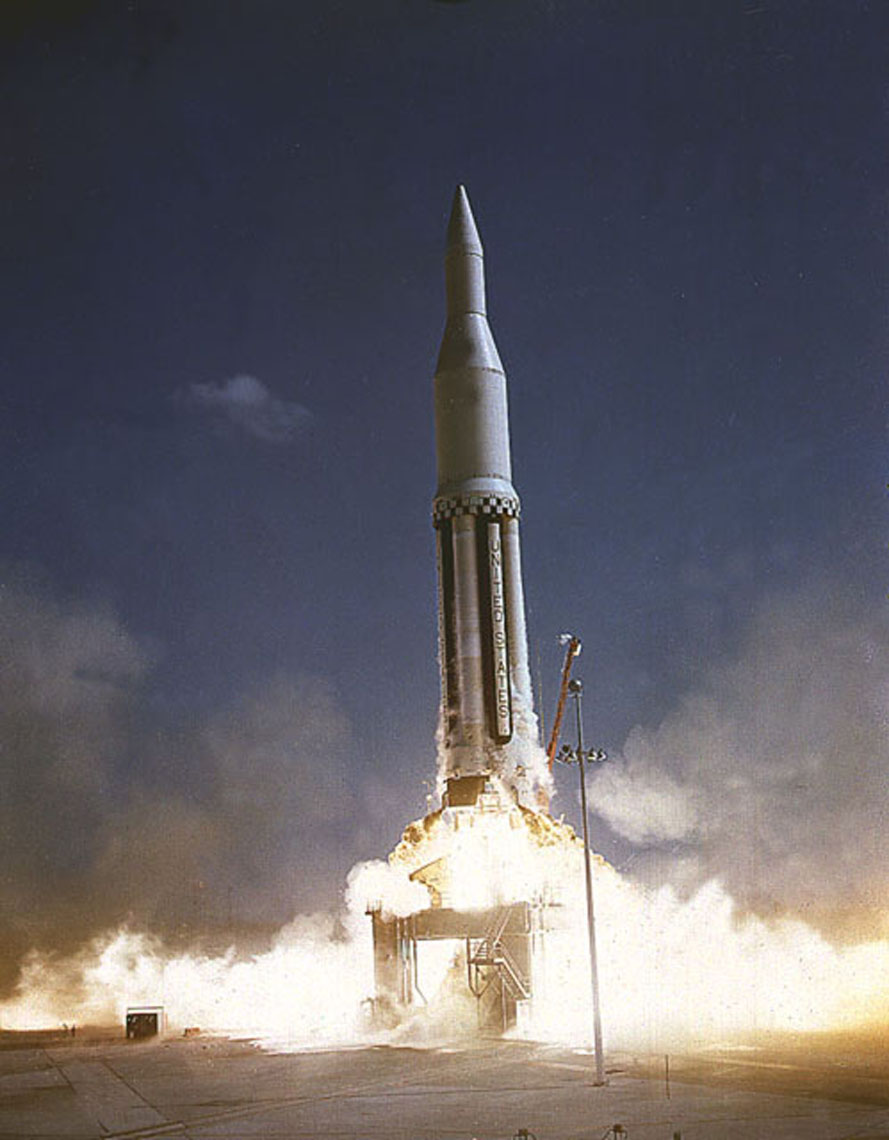
On April 25, 1962, the United States launched the second Saturn rocket into space. The suborbital flight was both a test of the booster as well as an interesting scientific experiment.

The Saturn-Apollo 2 vehicle had a standard S-IB first stage. The upper two stages were dummies ("battleships," in rocket parlance) filled with 95 tons of water. When the first stage cut off at about 65 miles altitude, the upper stages were detonated, and the water was released into the upper atmosphere. Rapidly-expanding ice clouds formed, and lightning-like static discharges were observed from the ground. The cloud continued moving upward to a height of about 100 miles.

Investigators were interested in examining the effects of a sudden discharge of liquid into the upper atmosphere (such as would happen if a rocket exploded at high altitude). They also tested the effects on radio transmissions from such a disturbance in the ionosphere.

Wednesday, April 22, 2009

On the Moon with Apollo 16

Apollo 16 landed in the Descartes Highlands of the Moon on April 21, 1972. John Young and Charlie Duke spent three days exploring the craters and mountains around their landing site.

This was another landing that almost didn't happen. After the Lunar Module Orion separated from the Command Module Casper, Ken Mattingly had difficulty with the backup system for steering the Service Module's main engine. This could have affected the crew's ability to return to Earth. The landing was delayed, and Orion and Casper flew in formation for 6 hours, until Mission Control assured the crew that everything was ok.

One of the most uncomfortable situations for the crew resulted from potassium supplements which had been added to their food and orange juice. Flight surgeons believed that the heart problems experienced by Apollo 15 moonwalkers Dave Scott and Jim Irwin were attributable to loss of potassium, so they added large doses of the mineral and citrus fruit to the Apollo 16 crew's diet. The potassium acted as a laxative, and the crew nearly depleted their supply of fecal bags. John Young was infamously and unknowlingly captured on his open mic talking to Charlie Duke about his reaction to the potassium: "I got the farts again, Charlie...I mean, I haven't eaten this much citrus fruit in 20 years! And I'll tell you one thing, in another 12 f*cking days, I ain't never eating any more."