Tuesday, July 21, 2009

An Apollo 11 Beta cloth patch

Shown here is a commemorative "patch" printed on Beta cloth, the fireproof Fiberglas material used to make the outer layer of the Apollo space suits. This patch was produced by Dow-Corning in celebration of its role in the Apollo 11 mission. Instead of the usual 4-inch diameter emblem, this one is 8 inches across. The piece of Beta cloth it's printed on (not all of which is shown here) is nearly 12 inches by 18 inches!

I had the item signed at Spacefest this year. Mike Collins and Buzz Aldrin signed for the crew. The two other signatures are from two other Apollo astronauts who were CAPCOM (capsule communicators) for the mission. Charlie Duke (later LMP on Apollo 16) was CAPCOM during the landing, and added his famous, "We copy you down, Eagle!" This made Duke the first human to talk to a astronauts on another heavenly body.

Bruce McCandless II, who never flew on Apollo but later was the first person to fly untethered in space, was CAPCOM during the Moon walk. He inscribed, "Neil, we can see you coming down the ladder now," which he said just after the TV camera was turned on and Armstrong was descending to the lunar surface. McCandless became the first person to talk to someone standing on another heavenly body.

Saturday, July 18, 2009

Monitoring Apollo 11

Perhaps the only people on Earth watching Apollo 11 more intently than me were the NASA folks in Launch Control and Mission Control. (Okay, I'll admit that perhaps that this is a slight exaggeration.) As glued as I was to my TV set, I was just an amateur. These folks were paid to stare at their screens, bite their nails, and chain smoke their way through the mission..

The Firing Room at Launch Complex 39, in a building adjacent to the Vehicle Assembly Building at Kennedy Space Center, was responsible for all operations from prior to launch until the vehicle rose completely above the launch tower, about 7 seconds after liftoff. The Firing Room staff controlled the preparation and execution of the launch sequence. The Firing Room staff also monitored all of the status readouts for the immense Saturn V rocket and the systems aboard the Apollo spacecraft, which was at the time the most complex machine ever built.

At the back of the Firing Room was a small glass-in enclosure known as the Operations Management Room. The team that worked in this area supervised the Firing Room and made the executive decisions. This is also where the VIPs (NASA brass like Werner von Braun) observed the launch. The red stripe on this badge indicates a security clearance for its bearer.

When the vehicle cleared the launch tower, control transferred to the famed Mission Operation Control Room (MOCR) was located, on the third floor of Bldg 30 (Mission Control Center, or MCC) at the Manned Spaceflight Center, now the Johnson Spaceflight Center, in Houston. The remainder of the mission, through splashdown, was run from this room. The badge shown at left was issued to Edward Pavelka, who supervised the Flight Dynamics Officer (FIDO) team for Apollo 11.

Other NASA Centers played a vital role in the Apollo 11 mission. For example, Goddard Spaceflight Center (GSFC), in the Maryland suburbs of Washington, DC, provided computer support and radar tracking of the flight through a network of ground-based sites. The colorful badge at left was issued to a GSFC employee for Apollo 11.

And, of course, contractors got their own badges, too. The example at the bottom of this blog was issued to George Faenza, a McDonnell Douglas employee who oversaw Apollo/Saturn testing during the Apollo era.

As a 12 year old boy during the mission, my role was to have my models of the Saturn V and the LM constantly at the ready in front of the TV, in case there was an urgent need to act out some portion of the mission as a critical event occurred. No one issued me a badge, but I belonged to that program!

Tuesday, July 14, 2009

July 1969: Moon Fever!!

In July 1969, the eyes of the world turned to the Kennedy Space Center in Florida, as we waited for the launch of Apollo 11.

NASA invited dignitaries and media representatives from around the world, and they gathered by the thousands. Even the most jaded person knew that this was not "just another launch" - this was a key landmark of human history, and everyone wanted to be there.

Those fortunate enough to be attending as invited guests received badges that would eventually become collector's items (for people like yours truly). In addition to the "Official Guest" badge, there was a more colorful VIP launch badge which is more commonly seen. A sample of this badge, which displays the mission patch, is shown at left.

The tens of thousands of people who gathered along the highways lining the Cape had to content themselves with unofficial, but nonetheless cherished, mementos of the occasion, such as the "Launch Witness Certificate" shown below. Everyone wanted to be able to prove "I was there!"

Thanks to worldwide, live TV (which wasn't even technologically possible a mere 7 years earlier in the decade!), people around the world were able to share in the event. We all watched as the countdown clock click inexorably downward. The final two minutes seemed interminable to me, yet the steps of launch sequence began happening so quickly that Public Affairs Officer (PAO) Jack King, the "Voice of NASA Launch Control," could barely keep up. I held my breath...

PAO: T minus 60 seconds and counting. We have passed T minus 60. 55 seconds and counting. Neil Armstrong just reported back: "It's been a real smooth countdown". We've passed the 50-second mark. Power transfer is complete - we're on internal power with the launch vehicle at this time. 40 seconds away from the Apollo 11 lift-off. All the second stage tanks now pressurized. 35 seconds and counting. We are still Go with Apollo 11. 30 seconds and counting. Astronauts report, "It feels good". T minus 25 seconds.

PAO: Twenty seconds and counting. T minus 15 seconds, guidance is internal. 12, 11, 10, 9, ignition sequence starts...6, 5, 4, 3, 2, 1, zero, all engine running, LIFT-OFF! We have a lift-off, 32 minutes past the hour. Lift-off on Apollo 11!

Tuesday, July 7, 2009

Apollo Saturn 203 - another test on the road to the Moon

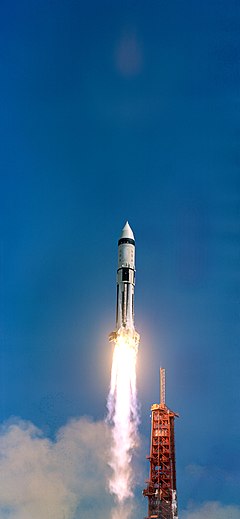
On July 5, 1966, NASA launched Apollo Saturn 203. It was the 6th launch of a Saturn vehicle in preparation for the eventual flight of manned Apollo spacecraft.

Apollo Saturn 203 (also sometimes informally called Apollo 2) provided the first flight test of restarting the S-IVB upper stage in orbit. This was a key requirement for manned flights to the Moon. The S-IVB was the third stage of the Saturn V rocket. It would first be used to put the Apollo spacecraft into orbit around the Earth while systems were checked out. After everything was confirmed to be okay, the S-IVB would fire again to send the spacecraft en route to the Moon. This was one of the first rocket stages to use liquid hydrogen as fuel. Engineers weren't entirely sure how liquid hydrogen would behave in the fuel tank in weightlessness, so the fuel tank was heavily instrumented for this flight.

Apollo Saturn 203 launched without an Apollo capsule on top, so its blunted nose looked quite unusual compared to subsequent Apollo flights. The liquid hydrogen fuel behaved as predicted in orbit, and the engine was successfully restarted. The S-IVB was certified as operational and ready to be used with a manned vehicle.

Another milestone was passed that would lead to landing men on the Moon just three years later.

Wednesday, July 1, 2009

Launching Apollo

I recently acquired three control and indicator panels that were in the Firing Rooms of the Launch Control Center at Kennedy Space Center during the Apollo era.

Two of these panels are for the S-IB, the first stage of the rocket that was used to launch Apollo 7, the Skylab crews, and the Apollo-Soyuz Test Project (ASTP). The panel at the top of this entry is the "S-IB Networks" control panel. It monitored the state of the electrical power transfer between the various stages of the Saturn rocket. Interestingly, this panel also includes switches for simulation as well as ignition. The stickers on the gauges at the top of the panel indicate its certification for use with the ASTP.

The panel at left is an "S-IB Operations" panel. It is composed strictly of indicator lights, but it has some very interesting ones, including "IGNITION," "ALL ENGINES RUNNING," and "LIFTOFF." I have already begun cleaning the plastic inserts over the indicator lights, getting rid of 40 years of accumulated gunk.

The third panel is for the S-IC, the first stage of the Saturn V rocket that launched the missions to the Moon, as well as Apollo 9 and the Skylab orbital workshop. This "S-IC Control and Purge" panel dealt with venting the oxygen that boiled off from the LOX tanks in the S-IC after the initial fueling of the vehicle several hours before liftoff.

When I was a kid, I used the top of a washing machine as a control panel and view screen when I played "Star Trek" with my friends. (The timer knob and start button were the only switches available, and we would open the lid to expose the 'view screen' - cutout pictures of the Enterprise and other vessels!) I'm tremendously excited about bringing these actual launch control panels into my life, as they were critical parts of the ground support equipment that made the Apollo program possible. It's quite a step up from the top of a washing machine!!

I'll be updating this blog regularly with my progress in researching and restoring these panels. Stay tuned.

Friday, June 26, 2009

Renovation of LM-2

The Lunar Module that is currently on display at the National Air and Space Museum is undergoing renovation. (See this article in Smithsonian online.)

The Smithsonian houses LM-2, the second Lunar Module built by Grumman. It was originally intended to fly in space as an unmanned test vehicle. However, the flight of LM-1 on Apollo 5 was so successful that NASA determined it was not necessary to fly LM-2. LM-2 was used for "drop tests" on Earth, to see how much stress the vehicle could take in simulated landings. As I posted in a blog entry last year, my dad actually saw the LM-2 ascent stage wrapped in plastic at the Manned Spaceflight Center in Houston in August, 1969.

After the flight of Apollo 11, NASA donated LM-2 to the Smithsonian. It went on display at what was then the Air and Space Museum, in the Arts and Industries Building, in late 1970 or early 1971. Here's how the LM looked in its old housing, in a photo I took in June 1971 - certainly seeming to me to be a jarring juxtaposition of 1880's architecture and the height of modern technology.

As mentioned in my blog entry earlier this week, I did some research for a Smithsonian curator in May 1971. When I gave him the results of the research, I asked him, "Can you recommend me for a job?" That took him aback! Here I was, a teenager, asking for a job at the Smithsonian! He told me that the only positions they had were for volunteer tour guides, which of course is exactly what I wanted. He recommended me to the docent coordinator, even though I was several years younger than the usual requirements (rising high school seniors).

Shortly after I began working as a tour guide, a curator made some adjustments to LM-2 to improve its display. Part of his work involved cutting off a small strip of the Kapton foil, the aluminized Mylar that covered the descent stage. Several of the other docents and I got small pieces of that Kapton foil from him. I kept it for several years in the same frame as my photo of Neil Armstrong.

In the current renovation of LM-2, the Smithsonian is removing all of the original Kapton from the Lunar Module and replacing it with something that I assume is equivalent but in better shape. I'm happy to have my little piece of history as a souvenir of my working "up close and personal" with this Lunar Module!

Tuesday, June 23, 2009

Our new Lunar Orbiters

Two new US space probes, the Lunar Reconnaissance Orbiter and LCROSS, entered orbit around the Moon today. These are the first US Moon probes since Clementine, which studied the Moon in the mid-1990's, and they will certainly entail our most detailed study of the Moon since Apollo.

To pave the way for Apollo, the US sent five appropriately named satellites (Lunar Orbiters I through V) into orbit around the Moon from August 1966 to August 1967. The Lunar Orbiters photographed the potential Apollo landing sites in high resolution, mapped more than 90% of the lunar surface at medium resolution, and discovered the "mascons" (mass concentrations) which cause the Moon's gravitational pull to be stronger in some spots. Combined with the data from the Ranger crash-landers and the Surveyor soft-landers, the US gained the information that it needed to send astronauts to orbit and land on the Moon.

The book illustrated above is NASA Publication SP-200, "The Moon as Viewed by Lunar Orbiter," from 1970. This is actually the oldest item in my collection which I bought with my own money. When I was in 8th grade, I was introduced to a curator from the Smithsonian, who had several poster-size Lunar Orbiter photographs that he could not identify. I offered to find out what they were for him. The only resource I was aware of was this recently-published book that I had seen at the public affairs office at NASA Headquarters. It cost $10, which was a lot of money to a kid who was only getting a $1.00 per week allowance. My dad suggested that to earn the money for the book, I should saw up a large tree that had fallen in our backyard. Much to his surprise (I was, after all, a bookish, overweight, nerd who was not predisposed to anything resembling physical labor), I took our bow saw and cut up the 40-ft. tree in one afternoon.

I was very pleased to have a real, official NASA publication of my very own. I spent a lot of time studying the photos. Perhaps the best part of the book was the four pages of 3-D anaglyphs. The book came with a set of red-blue glasses for the 3-D photos. The photo of the crater Tycho was particularly eye-popping!

I am pleased now that I can share in the images from LRO and LCROSS in real-time. In addition, the Lunar Orbiter Image Recovery Project (LOIRP) is applying modern image processing techniques to the original Lunar Orbiter data tapes, with astonishing results. All this , without my having to get out of my comfy chair, and without having to saw up trees!