Friday, January 16, 2009

Gettin' on the Space Station Program

In January 1987, I was a Contracts Manager for Boeing Computer Services, a division of The Boeing Company. I had just been pulled from the commercial contracts side of the house to the Government contracts section, because I had Government contract experience, and the company needed someone to manage the contract for a new project we had just won with the Army at Ft. McPherson, Georgia. Two weeks after I started that project, the contract award was protested by an unsuccessful bidder, and to our shock, the Army cancelled the contract.

As I was preparing to leave Atlanta to return to Washington, I got a call from my director. I was ordered to fly to Houston and go to Johnson Space Center, where we were being awarded a contract with NASA for the Space Station Freedom Technical and Management Information System (TMIS). I was to be the contract manager for this $350 million, 8-year project! I couldn't believe it...I was part of the space program! -- and totally without any effort on my part.

TMIS was NASA's way of bringing all the technical and design documents for the budding Space Station Freedom, no matter where in the country they were produced, into one system. This was before the Internet was accessible commercially, before there were common document formats. TMIS gave NASA the first capability to transmit and share rich-content documents across NASA centers. We were also implementing what was at the time one of the largest Oracle databases ever designed - several terabytes (which is pretty small by today's standards).

I was on the program for more than two years. My office was right across the parking lot from the Space Station Program office. I really enjoyed being able to say I was part of the program. Things got messy in 1989 when I became aware of some improper behavior by a NASA manager. I got drawn into a whistle-blowing situation and ended up being taken off of the program. I left Boeing a month later. And ultimately, Freedom never flew, although many of its design ideas were eventually used by the International Space Station program.

I found this TMIS paperweight on eBay in 2006, celebrating the completion of the Preliminary Design Review for the system.

Tuesday, January 13, 2009

The Bulls-eye on the Moon

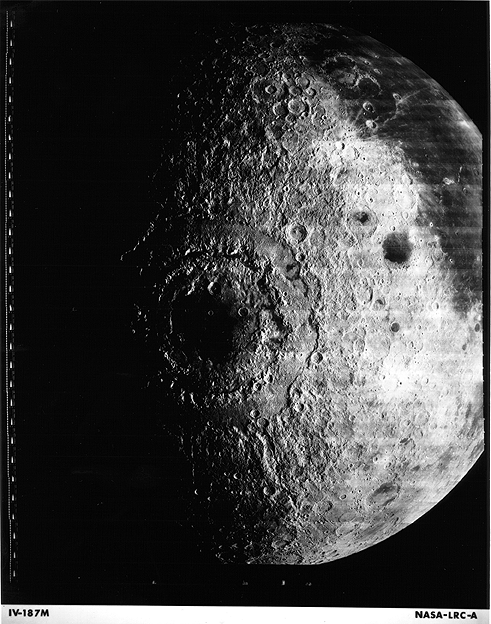
This week's full moon - supposedly one of the 'biggest' in many years (because the Moon was full when it was at perigee) - reminded me of a feature that we never really get to see from Earth, the Mare Orientale basin. It is just over the eastern rim of the Moon as seen from Earth, and is just becoming illuminated at full moon.

Telescopic observers have known about Mare Orientale since 1906. It sometimes peeks over the rim when the Moon is turned toward us the right way, and at best we can only see a portion of it, and that edge-on, from our vantage point on Earth. So, we all shared a collective gasp at the shock of seeing it when Lunar Orbiter 4 sent back the first dramatic image of it from directly overhead in 1967.

The 600-mile wide basin forms a perfect bulls-eye. The impact that created the feature left a dark 'sea,' and the resultant shock waves from the impact created two perfectly circular and concentric mountain ranges around the maria, the Rook Mountains and the Cordillera Mountains.

This feature is so huge that it could easily be visible with the naked eye from Earth if the Moon were rotated by 90 degrees. Scientists speculate that our ancestors would have evolved their own mythologies or religions based on Mare Orientale if it had been pointed at Earth.

This map is from the US Geological Survey from 1978. It shows the Orientale basin in great detail. This has always been one of my favorite lunar features. I have seen it edge-on in my telescope a couple of times, and I have seen the Rook and Cordillera Mountains as bumps on the rim of the Moon. I would dearly love to see it from lunar orbit someday!

Sunday, January 11, 2009

Skylab student project entry form

Here's a little something that I picked up at NASA Headquarters in the summer of 1971. It is an entry form for students to submit ideas for projects to be flown aboard Skylab.

NASA wanted to use Skylab not only for 'official' experiments from scientists and researchers, but also as an opportunity for creative ideas from students to be investigated. At this point in the space program, we didn't have experience with microgravity for more than a few days at a time, and the time and space available for experiments on the Apollo flights were next to nothing. Skylab offered the chance to see experiments unfold over the course of up to 84 days, and there was plenty of room to try new things.

An illustrative example cited in the application form was an experiment to investigate the behavior of paper airplanes in zero-g. Interestingly, Al Bean and his Skylab 2 crew actually played with paper airplanes in the cavernous Skylab interior. Bean noted that you had to make them with more folds than traditional Earth-bound paper airplanes. You also had to be careful not to give them too much lift (bending the ailerons up), or they would circle in ever-tighter spirals. Bean and crew almost filmed some of their experiments with the paper airplanes, but they decided not to, believing that the public would think they were wasting taxpayer money.

Perhaps the most famous of the Skylab student experiments was to see how spiders would spin webs in zero-g. Arabelle the spider became world-famous. Her initial webs were chaotic, but within a week, she spun normal webs just like those on Earth. Bean and crew were somewhat resentful of the attention that Arabelle got. The media paid much more attention to her than she did to all the other science being conducted on Skylab. Indeed, many people seemed to think that Arabelle was the only experiment being conducted on board, and they wondered why NASA would spend so much money and effort just to study spider webs in space.

Saturday, January 10, 2009

Skylab 3 Beta cloth crew patch

On January 10, 1974, the Skylab 3 crew (also known as SLM-4) was in its 55th day on board the Skylab space station, with another month to go in their mission. The crew, Jerry Carr, Bill Pogue, and scientist/astronaut Ed Gibson, stayed on board for 84 days. This was the first all-rookie American space crew since Gemini 8 in 1966.

The patch shown in this picture is printed on fireproof Beta cloth, the material that all Apollo-era space suits were made out of, following the Apollo 1 fire. It is from the personal collection of ED Gibson. The inset shows Gibson signing the patch.

Thursday, January 8, 2009

The last Surveyor en route to the Moon

Surveyor 7 was the last of the US's unmanned probes to soft-land on the Moon. It was launched on January 7, 1968, and landed three days later on the rim of the crater Tycho. It was a fitting and spectacular end to the Surveyor series.

The key question the Surveyors needed to answer was simply, "Is there a solid surface that will support the weight of a Lunar Module (and a man)?"

Before we sent the Surveyors, we literally had no idea what the surface of the Moon would be like. Would 4 billion years of impact by microscopic meteoroids create a layer of fine dust that was several feet or more deep? We did not know. We could make educated guesses, and while most scientists believed that there was a solid surface, there was not a consensus in the scientific community. We had to find out, or we risked our astronauts getting into a dangerous situation that they could not escape.

In yet another of their Space Firsts, the USSR beat the Americans to a soft landing on the Moon by about four months, landing Luna 9 on February 3, 1966. Luna 9 was the 12th attempt at a soft landing by the Soviets. The US's Surveyor 1 landed on June 2, 1966. At least the US could claim to have been successful on its first landing attempt.

The mid-1960's vintage tie tack depicted above represents the Surveyor lander. The image below is of a Surveyor engineering test article. I took this picture in the Smithsonian's Arts & Industries Building (first home of the Air and Space Museum) in July 1971.

Looking back on this some 38 years later, I can remember how exciting it was to have a relatively "new" spacecraft (less than 5 years old) so close at hand! This same Surveyor now hangs from the ceiling in the National Air and Space Museum, barely noticeable among all the other artifacts.

Monday, January 5, 2009

The birth of the Space Shuttle program

On January 5, 1972, President Nixon said that "The United States should proceed at once with development of an entirely new transportation system designed to help transform the space frontier of the 1970's into familiar territory, easily accessible for human endeavor in the 1980's and 1990's." Thus, NASA announced the Space Shuttle as the future of NASA's manned spaceflight program.

Apollo 16 had yet to be launched at this time. In fact, it was on April 21, 1972, literally at the moment that John Young was on the surface of the Moon doing his famous "jump salute" to the flag, that the CAPCOM relayed the news that the House had passed NASA's budget, which included funds for development of the Space Shuttle. Young replied, "The country needs that Shuttle mighty bad. You'll see. "

The pictured 1972 Space Shuttle brochure included some hopeful selling points for the Space Shuttle, many of which seem almost laughable with the benefit of 36 years' hindsight:
  • "Launch vehicle and satellite failures...will become things of the past."
  • "The shuttle is the only meaningful new manned space program which can be accomplished on a modest budget."
  • "You don't have to be an astronaut to ride the Space Shuttle...Passengers such as scientists, engineers and others will be able to ride in ordinary clothing, as in an airliner."
Delays and cost overruns would move the Shuttle's planned debut from 1977 to 1981. Two major catastrophic failures would cause the deaths of 14 astronauts. Spiraling costs and reduced tolerance for risk have limited the Shuttle's mission for nearly the past decade almost exclusively to construction of the International Space Station.

Those of us who grew up in the Apollo age feel like the Shuttle has kept us stuck in low Earth orbit, its massive budget swallowing up funds for developing other technologies. NASA will have to ground the Shuttle in 2010 to free up funds for construction of the next generation of manned spacecraft, which is an even more frustrating situation.

Things may not have turned out as originally envisioned, but the Shuttle has performed admirably in over 120 missions. The Shuttle launched Ulysses, Galileo, Magellan, and the Hubble Space Telescope. It enabled the first retrieval and repair of malfunctioning satellites. And it kept us in space for another 25 years.

Sunday, January 4, 2009

The Lunar Module rolls out to the launch pad

Forty years ago this week, the "Year of Apollo" began as the Saturn V stack for Apollo 9 was rolled out to the launch pad. It was only 11 days since Apollo 8 had blasted off from that same launch pad for the Moon!

Following the completion of Project Gemini in 1966, the next scheduled launch was Apollo 204 (later called Apollo 1), which was to lift off in February 1967. The launch pad fire that killed the crew also delayed the first Apollo launch until October 1968. So, nearly two years passed between Gemini 12 and Apollo 7, which seemed an interminable time as the end of the decade neared and Kennedy's challenge had yet to be fulfilled. The Soviet manned program had been on hold nearly the same amount of time, after Vladimir Komarov was killed in Soyuz 1 in April 1967.

So, the world had gone for a long time without manned space launches. And now, both the USSR and the US were back in space again and launches were coming very frequently. The US was so intent on getting to the Moon in 1969 that launches were planned every two months until a successful landing was achieved.

We certainly felt the anticipation and excitement. Apollo 8 had focused the public's attention to the space program once again. The Moon was now within reach, and there was new and exotic hardware to test before we could attempt a landing.

Apollo 9 would see the first manned flight of the Lunar Module. Apollo 9's LM was designated LM-3, and was later given the call-sign "Spider." LM-1 was a legless test article that flew on the unmanned Apollo 5. LM-2 was originally scheduled for another unmanned test, but after the success of Apollo 5, LM-2 was set aside for ground testing and eventually donated to the National Air and Space Museum.

This badge was from a worker for Grumman Aerospace Engineering Company, which built the Lunar Modules for the Apollo Program at their plant in Bethpage, New York.