Saturday, January 24, 2009

Opportunity on Mars - 5 years and counting

On January 24, 2004 (US time), the Mars rover "Opportunity" joined her twin sister, Spirit, on the surface of Mars. Spaceflight fans from around the world were once again able to follow the evens of entry, descent, and landing via live broadcast from the Jet Propulsion Laboratory in Pasadena.

When Opportunity sent back its first images shortly after landing, we were astonished to see what appeared to be cliff faces in the distance with outcrops of layered rock, the very thing Opportunity was sent to look for. It looked like a totally alien landscape compared to that in which Spirit landed. Spirit's landing site was strewn with volcanic rocks and looked very much like what we saw with the two Viking landers and the Mars Pathfinder. Opportunity's environs, on the other hand, showed no rocks at all on the surface around her, just sand, and what appeared to be cliff walls all around.

My first impression on seeing the first panorama from Opportunity was, "Gee, it landed in a crater!" Much to my delight, that turned out to be correct. The distant cliff walls were in fact only a few dozen feet away and were not much bigger than a roadside curb on Earth. Opportunity was able to drive over to the outcrop and explore it thoroughly in a couple of weeks.

With a 'warranted' lifetime of 90 sols and a couple of hundred meters of driving, Opportunity has really shown its mettle. It has lasted 5 Earth years on Mars and has driven 14 kilometers away from the crater in which it landed. It proved the past existence of surface water on Mars, spent much of a year inside Endurance Crater, photographed the wreckage of its own heat shield up close, returned the first images of a meteorite sitting on the surface of another planet, got stuck several times in sand dunes, survived a crippling dust storm, and most recently spent more than a year exploring Victoria Crater. It has now embarked on a multi-year, 12 km journey to Endeavour Crater. I hope she gets there!

I'm eternally grateful to JPL for giving the public immediate access to the photos from the rovers. Talented image specialists on sites such as unmannedspaceflight.com can quickly turn these into full-color or amazing 3D images for the world to see. With Spirit and Opportunity on the move, we get an unprecedented chance to "be there" on Mars while sitting in the comfort of our own homes.

These two launch team patches were produced before Spirit and Opportunity were given their names. MER-A became Spirit and MER-B was Opportunity.

Thursday, January 22, 2009

NASA tests the Lunar Module

On January 22, 1968, NASA launched the Apollo 5 mission, the first - and only - unmanned test of the Lunar Module. The Saturn I rocket used for the launch was the one originally intended to launch the Apollo 1 crew into space in 1967. It was undamaged by the capsule fire and was available for this flight.

Nothing like this had ever flown before - a spacecraft with an engine that could be throttled, and which would by itself not be capable of returning its crew to the Earth.

The LM was already 8 months behind schedule in its development. To prevent further delays, NASA decided to launch the LM without its landing gear, since the legs were not crucial to the test.

A software bug prematurely shut down the descent engine on its initial test. NASA engineers executed a workaround and were able to fire the descent engine twice, and then run a "fire in the hole" test of an emergency separation of the LM's descent and ascent stages.

The test was considered successful enough that a second planned unmanned flight of the LM was deemed unnecessary. The LM for that flight now sits in the National Air and Space Museum.

Tuesday, January 20, 2009

Happy birthday, Buzz Aldrin

Buzz Aldrin, the second human being to walk on the Moon, turns 79 years young today.

"Dr. Rendezvous" was not one of the more popular astronauts among his peers. However, no one could dispute his mastery of rendezvous theory (which was immensely useful in shaping the Gemini missions), or his flawless EVA techniques on Gemini XII, which proved that man could work effectively outside of a space capsule.

I put together this "Buzz at the ladder" diorama in 2006. It uses a Dragon 1/6 scale Buzz Aldrin figure, which is posable and remarkably detailed. The LM leg is made from wooden dowel and PVC pipe, wrapped in two colors of Mylar insulation blanket and Cadbury chocolate wrapper. The LM ladder rails and "rivets" are made from aircraft aluminum, which was kindly supplied by a fellow space enthusiast from collectSpace. I made the Apollo 11 commemorative "We came in peace for all mankind" plaque by scanning a photo of the actual LM plaque and printing it on aluminum colored contact paper.

I'm looking forward to meeting Buzz at Spacefest next month!

Sunday, January 18, 2009

Gemini 2

Gemini 2 was the second unmanned test flight of the 2-seat Gemini spacecraft. It was launched into a suborbital flight on January 19, 1965.

This flight was the first monitored from NASA's new Mission Control Center at the Cape. Shortly after launch, the Mission Control Center lost all power and blacked out. This failure was traced to overloaded electrical circuits from the network television equipment that was brought in to cover the flight!

The Gemini 2 capsule was the first US spacecraft that was reused in a subsequent spaceflight. After its mission, the capsule was in good enough shape that it was fitted with a new heat shield and new instrumentation - and flown as a test vehicle for the US Air Force's "Blue Gemini" (Manned Orbital Laboratory) program. It was the only Gemini vehicle that ever flew with USAF insignia.

Friday, January 16, 2009

Gettin' on the Space Station Program

In January 1987, I was a Contracts Manager for Boeing Computer Services, a division of The Boeing Company. I had just been pulled from the commercial contracts side of the house to the Government contracts section, because I had Government contract experience, and the company needed someone to manage the contract for a new project we had just won with the Army at Ft. McPherson, Georgia. Two weeks after I started that project, the contract award was protested by an unsuccessful bidder, and to our shock, the Army cancelled the contract.

As I was preparing to leave Atlanta to return to Washington, I got a call from my director. I was ordered to fly to Houston and go to Johnson Space Center, where we were being awarded a contract with NASA for the Space Station Freedom Technical and Management Information System (TMIS). I was to be the contract manager for this $350 million, 8-year project! I couldn't believe it...I was part of the space program! -- and totally without any effort on my part.

TMIS was NASA's way of bringing all the technical and design documents for the budding Space Station Freedom, no matter where in the country they were produced, into one system. This was before the Internet was accessible commercially, before there were common document formats. TMIS gave NASA the first capability to transmit and share rich-content documents across NASA centers. We were also implementing what was at the time one of the largest Oracle databases ever designed - several terabytes (which is pretty small by today's standards).

I was on the program for more than two years. My office was right across the parking lot from the Space Station Program office. I really enjoyed being able to say I was part of the program. Things got messy in 1989 when I became aware of some improper behavior by a NASA manager. I got drawn into a whistle-blowing situation and ended up being taken off of the program. I left Boeing a month later. And ultimately, Freedom never flew, although many of its design ideas were eventually used by the International Space Station program.

I found this TMIS paperweight on eBay in 2006, celebrating the completion of the Preliminary Design Review for the system.

Tuesday, January 13, 2009

The Bulls-eye on the Moon

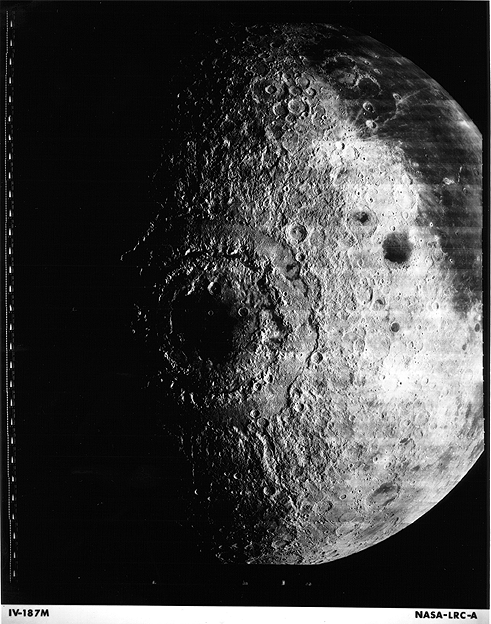
This week's full moon - supposedly one of the 'biggest' in many years (because the Moon was full when it was at perigee) - reminded me of a feature that we never really get to see from Earth, the Mare Orientale basin. It is just over the eastern rim of the Moon as seen from Earth, and is just becoming illuminated at full moon.

Telescopic observers have known about Mare Orientale since 1906. It sometimes peeks over the rim when the Moon is turned toward us the right way, and at best we can only see a portion of it, and that edge-on, from our vantage point on Earth. So, we all shared a collective gasp at the shock of seeing it when Lunar Orbiter 4 sent back the first dramatic image of it from directly overhead in 1967.

The 600-mile wide basin forms a perfect bulls-eye. The impact that created the feature left a dark 'sea,' and the resultant shock waves from the impact created two perfectly circular and concentric mountain ranges around the maria, the Rook Mountains and the Cordillera Mountains.

This feature is so huge that it could easily be visible with the naked eye from Earth if the Moon were rotated by 90 degrees. Scientists speculate that our ancestors would have evolved their own mythologies or religions based on Mare Orientale if it had been pointed at Earth.

This map is from the US Geological Survey from 1978. It shows the Orientale basin in great detail. This has always been one of my favorite lunar features. I have seen it edge-on in my telescope a couple of times, and I have seen the Rook and Cordillera Mountains as bumps on the rim of the Moon. I would dearly love to see it from lunar orbit someday!

Sunday, January 11, 2009

Skylab student project entry form

Here's a little something that I picked up at NASA Headquarters in the summer of 1971. It is an entry form for students to submit ideas for projects to be flown aboard Skylab.

NASA wanted to use Skylab not only for 'official' experiments from scientists and researchers, but also as an opportunity for creative ideas from students to be investigated. At this point in the space program, we didn't have experience with microgravity for more than a few days at a time, and the time and space available for experiments on the Apollo flights were next to nothing. Skylab offered the chance to see experiments unfold over the course of up to 84 days, and there was plenty of room to try new things.

An illustrative example cited in the application form was an experiment to investigate the behavior of paper airplanes in zero-g. Interestingly, Al Bean and his Skylab 2 crew actually played with paper airplanes in the cavernous Skylab interior. Bean noted that you had to make them with more folds than traditional Earth-bound paper airplanes. You also had to be careful not to give them too much lift (bending the ailerons up), or they would circle in ever-tighter spirals. Bean and crew almost filmed some of their experiments with the paper airplanes, but they decided not to, believing that the public would think they were wasting taxpayer money.

Perhaps the most famous of the Skylab student experiments was to see how spiders would spin webs in zero-g. Arabelle the spider became world-famous. Her initial webs were chaotic, but within a week, she spun normal webs just like those on Earth. Bean and crew were somewhat resentful of the attention that Arabelle got. The media paid much more attention to her than she did to all the other science being conducted on Skylab. Indeed, many people seemed to think that Arabelle was the only experiment being conducted on board, and they wondered why NASA would spend so much money and effort just to study spider webs in space.