Saturday, April 25, 2009

Staking my claim to lunar real estate

On April 27, 1972, when I was in high school, I purchased from Lunar Services Corporation of Alexandria, Virginia, a deed to a small portion of lunar real estate near the crater Agrippa, for the grand total of $5.00. The purchase was documented with the quitclaim deed shown in this post, as well as several lunar maps.

I would have been surprised in 1972 to hear that it may be 50 years before anyone goes back to the Moon. I guess my chances of putting my own feet on "my property" are pretty slim. I'm especially upset that Lunar Services Corporation is apparently no longer around to help me assert my claim!

Friday, April 24, 2009

Project Highwater

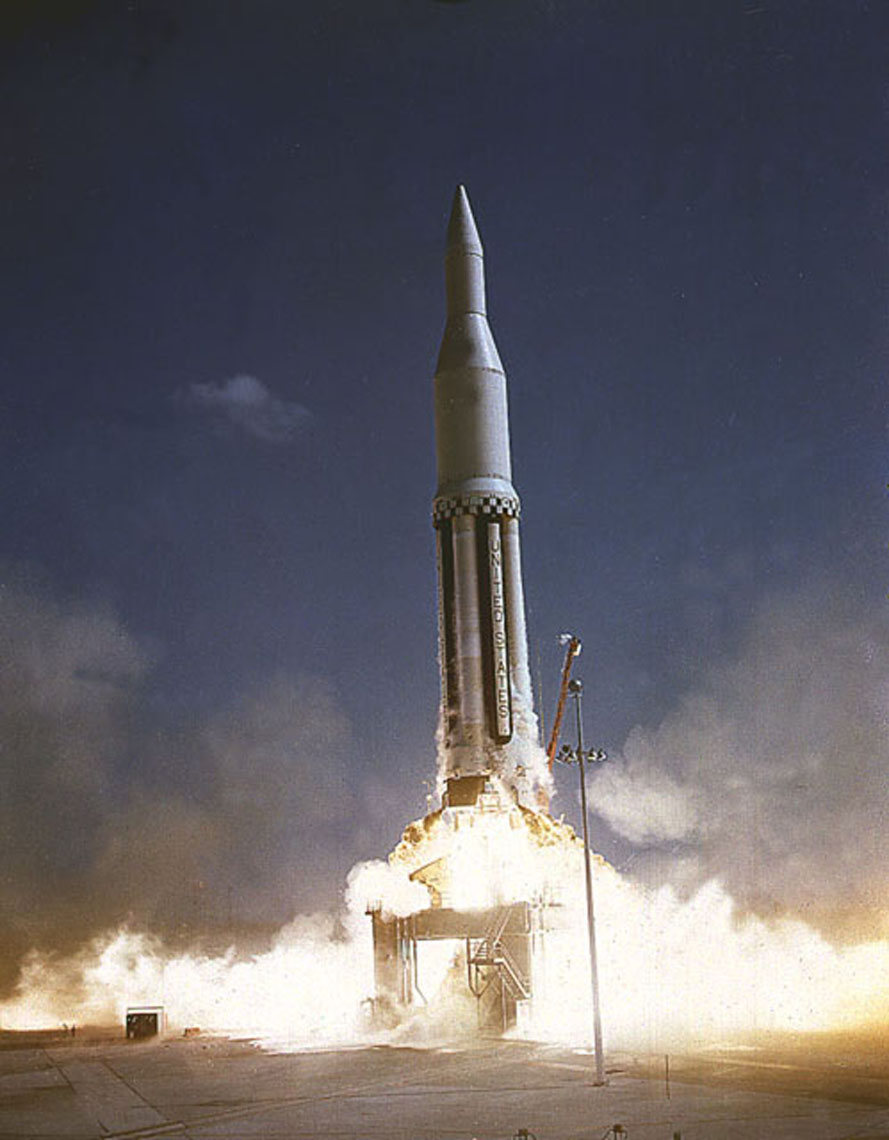
On April 25, 1962, the United States launched the second Saturn rocket into space. The suborbital flight was both a test of the booster as well as an interesting scientific experiment.

The Saturn-Apollo 2 vehicle had a standard S-IB first stage. The upper two stages were dummies ("battleships," in rocket parlance) filled with 95 tons of water. When the first stage cut off at about 65 miles altitude, the upper stages were detonated, and the water was released into the upper atmosphere. Rapidly-expanding ice clouds formed, and lightning-like static discharges were observed from the ground. The cloud continued moving upward to a height of about 100 miles.

Investigators were interested in examining the effects of a sudden discharge of liquid into the upper atmosphere (such as would happen if a rocket exploded at high altitude). They also tested the effects on radio transmissions from such a disturbance in the ionosphere.

Wednesday, April 22, 2009

On the Moon with Apollo 16

Apollo 16 landed in the Descartes Highlands of the Moon on April 21, 1972. John Young and Charlie Duke spent three days exploring the craters and mountains around their landing site.

This was another landing that almost didn't happen. After the Lunar Module Orion separated from the Command Module Casper, Ken Mattingly had difficulty with the backup system for steering the Service Module's main engine. This could have affected the crew's ability to return to Earth. The landing was delayed, and Orion and Casper flew in formation for 6 hours, until Mission Control assured the crew that everything was ok.

One of the most uncomfortable situations for the crew resulted from potassium supplements which had been added to their food and orange juice. Flight surgeons believed that the heart problems experienced by Apollo 15 moonwalkers Dave Scott and Jim Irwin were attributable to loss of potassium, so they added large doses of the mineral and citrus fruit to the Apollo 16 crew's diet. The potassium acted as a laxative, and the crew nearly depleted their supply of fecal bags. John Young was infamously and unknowlingly captured on his open mic talking to Charlie Duke about his reaction to the potassium: "I got the farts again, Charlie...I mean, I haven't eaten this much citrus fruit in 20 years! And I'll tell you one thing, in another 12 f*cking days, I ain't never eating any more."

Saturday, April 18, 2009

Farewell Aquarius, and we thank you

April 17, 1970 saw the crew of Apollo 13 return to Earth after their harrowing journey.

This photo commemorates one of the heroes of Apollo 13, the Lunar Module Aquarius, which helped to bring the crew home safely. Aquarius provided shelter, oxygen, and water, which kept the crew alive, and an engine, which brought the crew home.

The inscriptions on this photo tell a little of Apollo 13's story. First, Jack Lousma, who was the CAPCOM at the time of the accident, communicated to the crew that the Command Module wouldn't be able to keep them alive, saying, "We're starting to think about the LM lifeboat." In the lower right corner, Joe Kerwin, who was CAPCOM at the end of the Apollo 13 voyage, has written what he spoke just after Aquarius was jettisoned and before the Command Module re-entered: "Farewell, Aquarius, and we thank you!"

Two of the crew members, Jim Lovell and Fred Haise, would have flown Aquarius to the lunar surface, also inscribed this photo. Lovell has written on this photo, "LM Aquarius, jettisoned 11:43 am EST, 4/17/1970 - She was a good ship!" and Fred Haise added, "Our lifeboat!"

Aquarius was a space vehicle that was pressed into service to do things it was never intended to do - keep 3 crew members alive for 4 days - and did them remarkably well.

Monday, April 13, 2009

Another first to celebrate

April 12 is a special date in the history of manned spaceflight. As noted in my previous post, it was the date of Yuri Gagarin's launch in 1962. Twenty years later to the day, the Space Shuttle took its first trip into space.

The launch of STS-1 was record setting in many regards - first launch of a winged manned spacecraft, first re-usable spacecraft, first time humans had flown on a booster powered by solid rocket motors, first time a spacecraft had been ridden by people before it had been tested unmanned. John Young, the STS-1 Commander and NASA's most experienced astronaut, was flying his fifth space mission. He was now the first person to have flown in four different types of space vehicles (Gemini, Apollo Command Module, Apollo Lunar Module, and Space Shuttle).

Since the Shuttle had never been launched into space before, there was a tremendous number of unknowns about how everything would work. After Columbia reached orbit, the crew discovered that several tiles from the heat shield were missing, and no one knew whether this would affect the ability of the craft to survive re-entry. After Columbia successfully returned, engineers discovered that the force of booster ignition had moved the Orbiter's body flap farther than it was designed to move. This could have rendered the craft unable to glide to a landing. Young said that had he been aware of the condition during launch, he probably would have aborted the mission, which would have destroyed Columbia and might well have been the end of the Space Shuttle program.

I watched Columbia's return from the Public Affairs auditorium at NASA Headquarters, which was just up the street from where I worked in Washington, DC. It was a nail-biting experience waiting for the Shuttle to emerge from radio blackout during re-entry! And of course, the crowd assembled in the auditorium erupted into tremendous applause after Columbia touched down at Edwards Air Force Base.

Saturday, April 11, 2009

Happy Yuri's Night

Early in the morning of April 12, 1961, a Vostok spacecraft carrying Yuri Gagarin (1934-1968) was launched from the secret Soviet base at Turyatam. Gagarin became the first human in space and the first man in orbit.

For nearly 30 years, the Soviets hid the fact that Gagarin ejected from his spacecraft about 23,000 ft above the ground. For the flight to have been officially declared a spaceflight under FAI rules, Gagarin would have had to land inside the capsule.

Whether this was an "official" flight or not, nothing can detract from Gagarin's heroism in taking this first flight into the unknown. "Yuri's Night" is now celebrated at parties all around the world.

This postcard from 1962 bears the pre-printed signature of Gagarin at bottom, as well as his hand signature along the right-hand side.

Friday, April 10, 2009

Launching Apollo 13

On April 11, 1970, the US launched what may be (in our day) the Apollo mission that more people have heard about than any others - Apollo 13. Thanks to Ron Howard's film, the words, "Houston, we have a problem" - even though a misquote of Jim Lovell - are just about as famous as Neil Armstrong's words on his first step onto the Moon.

Apollo 13 lifted off from Pad 39A at 13:13 Houston time. The ascent into orbit was far from ordinary. As the second stage pushed the craft toward orbit, violent "pogo" oscillations caused the center engine to cut out 2 minutes early. Had the engine not cut out, the entire vehicle might have been torn apart by vibrations that reached 68 times the force of gravity. The other four engines burned longer to compensate for the loss of thrust, and Apollo 13 eventually achieved a normal orbit.

The crew felt that this brush with danger was their major glitch for the flight. Everyone breathed a sigh of relief and thought that things would go smoothly for Apollo 13 from there on out.

The first badge on this post was an access pass for official guests to view the launch. The other two badges gave access to the Firing Room, the headquarters at Kennedy Space Center which is responsible for overseeing the launch of a vehicle. Once the vehicle has "cleared the tower," responsibility for the mission is passed on to Mission Control in Houston.